
Blog
Technical File Compilation Automation: Agentic Agents
For decades, the standard for technical documentation in highly regulated industries has been the template. Whether you are in life sciences, aerospace, or advanced manufacturing, the process was the same: start with a static Word or PDF structure, manually hunt for data across fragmented systems, and copy-paste your way to a compliant dossier. It was a linear, labor-intensive, and fundamentally reactive method.
However, as we move through 2026, the complexity of global regulations and the sheer volume of technical data have rendered traditional templates obsolete. The industry is witnessing a paradigm shift from “static filling” to “autonomous orchestration.” At the heart of this transformation is Agentic models.
Unlike traditional automation that follows a rigid script, Agentic AI acts with intent. It does not just wait for a human to provide an input; it understands the goal, plans the steps, and executes the compilation of complex technical files with minimal supervision.
The Evolution: From Static Templates to Autonomous Agents
To understand why Agentic AI is a game changer, we must first look at the limitations of the tools that came before it.
1. The Limits of Generative AI Chatbots
Standard Generative AI can draft sections of text, but it lacks the “agency” to manage a 500-page regulatory submission. A chatbot can tell you what a Common Technical Document (CTD) should look like, but it cannot autonomously log into your LIMS (Laboratory Information Management System), verify the latest stability data, and cross-reference it with the manufacturing section of your file.
2. The Agentic Difference
Agentic AI represents a shift from task-based automation to goal-based autonomy. You do not tell the system to “copy cell A1 to document B.” Instead, you give it a mission: “Compile the Technical File for Product X for an EU MDR submission, ensuring all stability data from 2025 is included and formatted per Annex II.”
The AI then:
- Perceives the regulatory requirements.
- Plans the document structure based on the specific product class.
- Retrieves data from disparate silos (ERP, Quality Management Systems, Clinical databases).
- Reflects on the output to ensure consistency across sections.
How Agentic / Agents Automate the Technical File Lifecycle
Technical file compilation is not a single event; it is a continuous lifecycle of data gathering, synthesis, and validation. Agentic AI excels at every stage of this journey.
1. Multi-System Data Orchestration
One of the greatest bottlenecks in technical writing is data fragmentation. A single technical file might require data from R&D, Clinical, Regulatory, and Manufacturing departments.
Agentic AI uses “tools” and “connectors” to bridge these gaps. It can autonomously navigate through various software ecosystems, pulling real-time data instead of relying on stale exports. Because these agents understand context, they can identify which version of a document is the “final approved” version, eliminating the risk of using superseded data.
2. Intelligent Document Synthesis
In the old world, a template provided the headers, but the human did the “stitching.” Agentic AI uses Multi-Agent Systems (MAS) to divide and conquer.
- Specialized Agent A might focus solely on the Chemical, Physical, and Biological properties.
- Specialized Agent B might focus on Clinical Evaluation Reports.
- The Orchestrator Agent then reviews both outputs to ensure that a change in the manufacturing process (noted by Agent A) is accurately reflected in the risk assessment (managed by Agent B).
This internal “conversation” between agents ensures a level of document integrity that is nearly impossible to maintain manually.
3. Real-Time Regulatory Alignment
Regulations are not static. The FDA, EMA, and other global bodies frequently update their guidance. In a template-driven world, a change in regulation means updating every template and retraining every writer.
Agentic AI platforms are connected to regulatory intelligence feeds. When a new guideline is released, the agents “learn” the new requirement and apply it to the file currently in progress. This proactive compliance prevents the dreaded “Request for Information” (RFI) loops that often delay product launches.
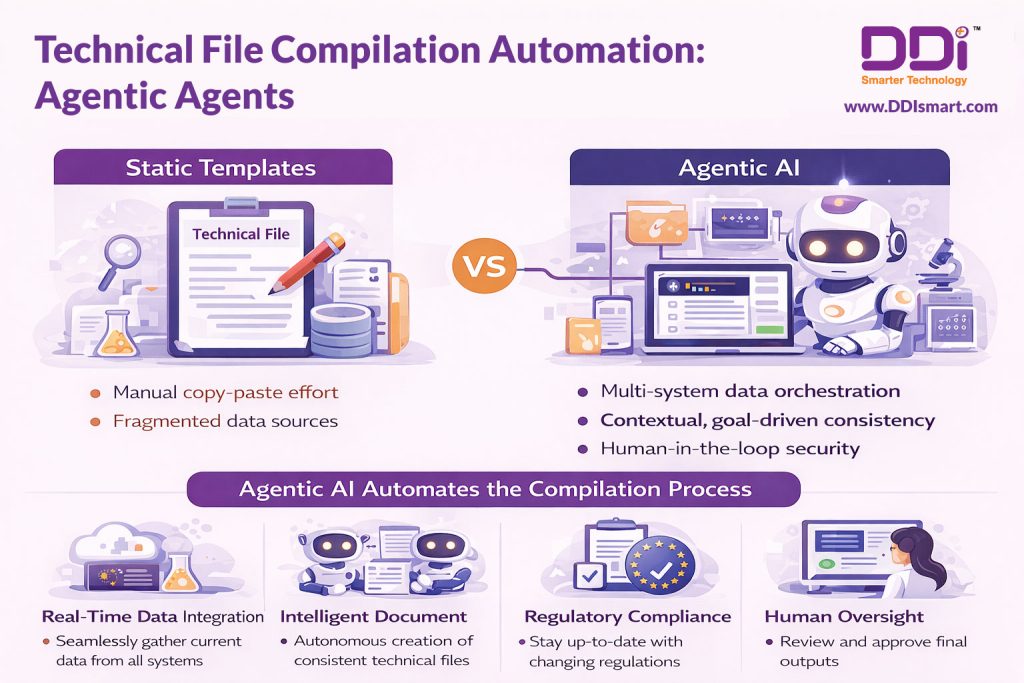
The “Human-in-the-Loop” Security Layer
A common misconception is that “autonomous” means “unsupervised.” In reality, the best Agentic AI platforms for technical files are designed with Human-in-the-Loop (HITL) architecture.
The AI does the heavy lifting: the searching, the drafting, the formatting, and the initial validation. However, it presents the finished sections to the human subject matter expert (SME) for final approval. The AI can even highlight the specific areas where it felt “uncertain,” allowing the human to focus their expertise where it matters most, rather than proofreading page numbers and margins.
| Feature | Traditional Templates | Agentic AI Platforms |
| Data Entry | Manual / Copy-Paste | Autonomous System Retrieval |
| Reasoning | None (Human-led) | Contextual & Goal-oriented |
| Adaptability | Rigid (Breaks with change) | Dynamic (Learns & Adjusts) |
| Speed | Weeks to Months | Days or Hours |
| Accuracy | High Human Error Risk | High Consistency & Auditability |
Business Impact: Why The Switch Is Non-Negotiable
The transition to Agentic AI is driven by more than just a desire for “cool tech.” It is a business imperative.
- Accelerated Time-to-Market: By reducing the technical file compilation time from months to days, companies can gain a first-mover advantage in competitive markets.
- Resource Optimization: Highly paid scientists and engineers should not be spending 40% of their time on document formatting. Agentic AI returns that time to them for innovation.
- Reduced Compliance Risk: Manual compilation is prone to “copy-paste errors,” where data from one product accidentally ends up in the file of another. AI agents eliminate these transpositions by pulling directly from the source of truth.
- Scalability: As a company expands its product portfolio, the volume of documentation grows exponentially. Agentic AI scales horizontally without requiring a proportional increase in headcount.
The Future of Technical Files
We are entering an era where the “document” itself might become secondary to the “data.” In the near future, regulatory submissions may not be PDFs at all, but rather “Digital Twins” of the technical file, curated and maintained by AI agents that live alongside the product throughout its entire market life.
For organizations still clinging to Word templates and manual trackers, the gap is widening. The complexity of 2026 and beyond requires a system that can think as fast as the market moves.
Take the Next Step in Automation
Transitioning to an autonomous enterprise requires the right foundation. DDi offers a sophisticated suite of tools designed to move your organization beyond the limits of traditional software. By integrating domain-specific intelligence with autonomous execution, you can transform your regulatory and technical workflows into a competitive powerhouse.
Ready to revolutionize your technical file compilation? Explore how you can achieve seamless efficiency with the Agentic AI Platform and Process Automation by DDi.
Get the latest updates from DDi
Explore Topics
Recent Blogs
 Medical Device Data Is Gr…In Regulations
 Master Data Management: E…In UDI
- Best eIFU Software: Top E…In Regulations


CONNECT WITH US

Let's talk about how DDi can help you