Document Authoring & Operations AI Agents

Raising your AI document processing to the next level, from Authoring to Formatting to Country specific Publishing.

Publishing Agent

Take the hassle out of document publishing. This Agent reviews, formats, and fixes issues in documents to meet global regulatory standards -such as FDA, EMA, and other health authorities -reducing manual errors and last-minute rework. Get your documents submission-ready faster, with fewer delays, less manual efforts and more confidence.

Formatting Agent

Bring consistency and quality to every document without manual formatting. With our proven rules, this Agent applies the right formatting options your teams choose, whether it’s a standard bundle for Agency requirements or based on your internal rule books and templates. Save time, reduce errors, and ensure writers time is efficiently used.

QC Agent

For key documents, companies spend multiple rounds on QC leading to longer cycles. Also, QC most often lacks Consistency as it’s subjective based on Reviewer’s experience/perceptions. Whether it is simple QC or deeper content checking, leverage our QC Agents to speed up the process and reduce manual efforts.

Authoring Agent

This Agent produces first draft sections for human review so that teams spend more meaningful time on high-value reviews and other activities. Also included is AI-generated assistance to help authors improve new or existing content. With this feature, authors can receive AI-generated assistance for their context aware content.

GenAI Agent

This agent does text summarization using GenAI. For teams in life sciences, summarizing regulatory and clinical events can be time-consuming task. Streamline text summaries across various type of events including regulatory alerts, agency responses, strategy summaries and more.

How our Agents Help Your Document Teams

DDi empowers Document teams to automate routine tasks, manual activities and processes – freeing them to focus on stake holder engagement and project delivery on-time/on-budget.

40%

Overall Cost Reduction in Document Ops

40 to 100/Hr

Up Arrow

Documents Processed

<1%

Up Arrow

Error Rate in Compliance

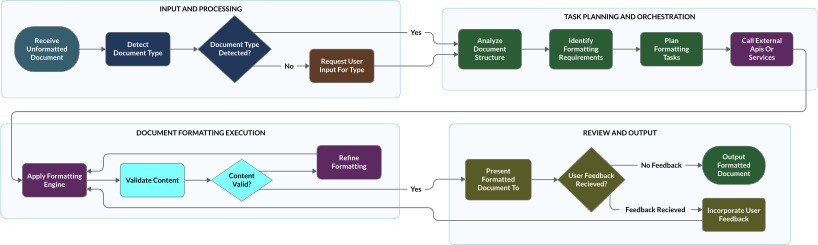
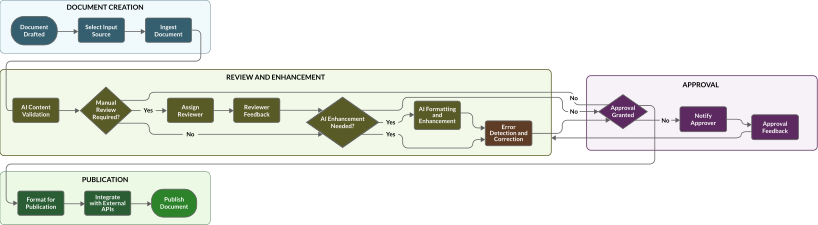
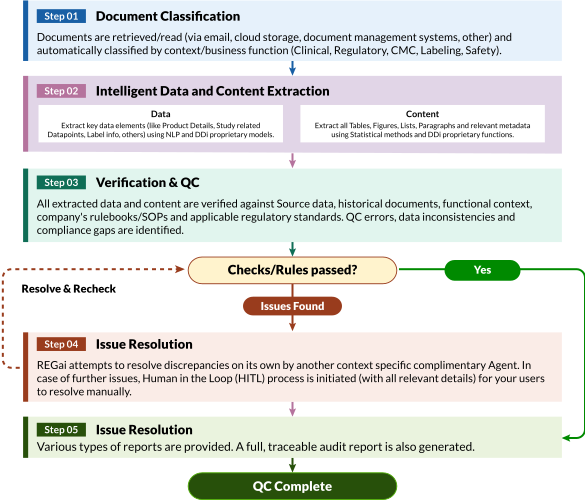
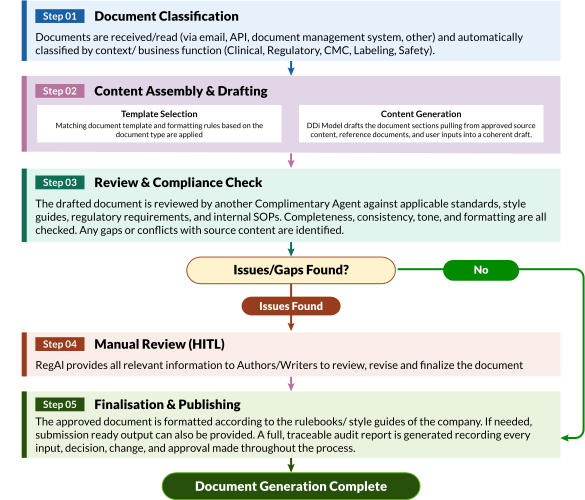
Illustrative Workflow Templates

Formatting Automation Workflow

Publishing Automation Workflow
Document Quality Control Automation Workflow
Document Generation Automation Workflow
×

Deploy your Platform AI Agents in 4 Easy Steps

Agent Discovery

Conduct workshop(s) with relevant stakeholders to identify and prioritize use cases and map the requirements.

Agent Discovery

Agent Setup

Develop and launch your first agent with basic logic and integration (process scoping and recording, test dataset with few examples, baseline agent running and testing with target output mapping).

Agent Setup

Agent Training

Test performance and gather feedback from process users (agent optimization up to 80% against expected output, variable-level accuracy measurement and optimization, integrations setup, and feedback).
Agent Training

Agent Live

Extend to more workflows and other teams (live and continuous monitoring, human-in-the loop interfacing, automated prompt enhancements, >90% accuracy improvement, constant business logic improvements).

Agent Live

Looking to automate document operations (Publishing, Formatting, QC) or AI Authoring assistance?

Frequently Asked Questions (FAQs)

1. What are Document Operations & Authoring AI Agents?
Document Operations & Authoring AI Agents are intelligent systems that automate key document-related activities such as authoring, formatting, quality control, publishing, and summarization. In regulated life science environments, these agents help improve speed, consistency, and compliance across regulatory and clinical documentation.
2. How do AI agents improve regulatory document management?
AI agents reduce manual effort by automating repetitive and rule-based document tasks. They ensure documents follow regulatory standards, apply consistent formatting, perform quality checks, and prepare submission-ready outputs—helping teams reduce rework, errors, and cycle times.
3. Can these AI agents support global regulatory publishing requirements?
Yes. Publishing AI Agents are designed to review and format documents to align with global regulatory authority requirements, including FDA, EMA, and other health agencies. This helps ensure documents are compliant across regions and reduces last-minute publishing issues.
4. How does the Formatting AI Agent maintain consistency across documents?
The Formatting AI Agent applies predefined rules, templates, and formatting standards selected by your teams. Whether based on agency-specific requirements or internal style guides, it ensures consistency across documents while eliminating manual formatting work.
5. What role does the QC AI Agent play in document review?
QC AI Agents help accelerate quality checks by identifying formatting issues, inconsistencies, and content-level deviations. By standardizing QC processes, these agents reduce subjectivity, improve consistency, and shorten review cycles for critical documents.
6. Can AI agents assist with regulatory and clinical document authoring?
Yes. The Authoring AI Agent generates first-draft sections for human review and provides contextual AI-assisted writing support. This allows authors to focus on high-value analysis and refinement rather than starting from scratch.
7. How does the GenAI Agent support document summarization?
The GenAI Agent helps summarize large volumes of regulatory and clinical content, such as agency communications, regulatory alerts, and strategy documents. This enables teams to quickly understand key points without manually reviewing lengthy materials.
8. Are these AI agents suitable for highly regulated life science environments?
Absolutely. These agents are designed with compliance, traceability, and accuracy in mind. They support structured workflows, audit-ready outputs, and consistent application of regulatory rules—making them suitable for regulated industries such as biopharma, medical devices, and consumer health.
9. Can Document AI Agents integrate with existing document management systems?
Yes. Document Operations AI Agents can integrate with enterprise document and content management systems, enabling seamless automation without disrupting existing workflows or repositories.
10. How do AI agents help reduce document processing errors?
By automating formatting, QC, and rule-based checks, AI agents significantly reduce human errors. Consistent application of predefined rules ensures accuracy, while automated validation minimizes oversight and compliance risks.
11. How quickly can teams start using Document AI Agents?
Teams can begin with targeted use cases such as formatting or QC and gradually expand to authoring and publishing. With a structured setup and training approach, organizations can start seeing value within a short implementation timeframe.
12. What measurable benefits do Document Operations AI Agents deliver?
Organizations using Document AI Agents experience faster document processing, lower operational costs, reduced error rates, and improved compliance. Automation allows teams to handle higher document volumes without increasing manual effort.
13. Can these AI agents support country-specific publishing needs?
Organizations using Document AI Agents experience faster document processing, lower operational costs, reduced error rates, and improved compliance. Automation allows teams to handle higher document volumes without increasing manual effort.
14. How do AI agents support collaboration across document teams?
AI agents act as consistent digital assistants that apply shared rules and standards across teams. This reduces dependency on individual expertise, improves collaboration, and ensures uniform document quality across functions and geographies.
The First Step

Let's talk about how DDi can help you